A buyer may love the idea of an easy, elegant, beginner friendly updo accessory, but sourcing success depends on much more than trend appeal. When retailers, salon brands, gift shops, and private label sellers look for a hair accessory for French twist styling, they need products that not only look refined in photos but also perform consistently across different hair types, lengths, and daily use conditions. That is where sourcing decisions become highly practical: grip strength, tip finishing, plating quality, color consistency, packaging, and MOQ can determine whether a quick reorder becomes a long-term bestseller or a high-return item.
The French twist remains a reliable style reference because it blends classic polish with low-effort wearability. Fashion media coverage has kept interest alive by framing French hair pins and updo tools as the secret to chic styling with fewer steps. For B2B buyers, this matters because the category works across several wholesale segments at once: fashion accessories, beauty retail, gifting, seasonal sets, salon add-ons, and online private label collections. A strong supplier strategy should therefore look beyond a single pin and consider the full assortment opportunity, from metal U-shaped pins and acetate sticks to claw clips, barrettes, bobby pins, and decorative combs that support French-inspired updos.
For buyers building assortments or private label programs, https://blaccessory.com/ can be evaluated as a source for broader hair accessory development, especially when the goal is to combine classic styling tools with commercially viable packaging and repeat-order consistency.
Why French Twist Accessories Matter in Wholesale Hair Accessory Planning
The French twist is not just a styling idea; it is a merchandising concept. It gives buyers a clear usage story: quick office styling, event-ready hair, low-maintenance elegance, and day-to-night wear. That usage story is important because accessories with a visible styling purpose often convert better in retail than decorative items without an obvious function. A buyer choosing French twist-related products is not simply selecting hair pins. They are selecting a solution-led accessory line.
There are several B2B reasons this niche deserves attention. First, it works across multiple materials and price tiers. A simple metal French hair pin may suit entry-level retail, while acetate, faux pearl, rhinestone, or resin versions can target boutique channels and giftable collections. Second, the visual language is timeless rather than fast-expiring, which helps reduce trend risk. Third, the category can easily expand into coordinated groups that include claw clips, French twist combs, bobby pins, and decorative barrettes in matching finishes.
Buyers should also note that a product promoted as easy, quick, or beginner friendly must be designed for actual usability. In wholesale terms, that means testing not only visual appeal but insertion angle, curve balance, point smoothness, and holding stability. One common sourcing mistake is to choose a pin based only on photo aesthetics, only to find that the accessory slips on thick hair or feels too sharp for fine hair users.
Useful decision factors at this stage include:
- Whether the item is intended as a functional core SKU or a trend-led seasonal add-on
- Which hair types the design is meant to support: fine, medium, thick, curly, or long hair
- What retail channel will sell it: e-commerce, boutique, drugstore beauty, salon, or gifting
- How the product will be displayed: hanging card, gift set, tray display, or simple polybag packing
- Whether repeat orders require consistent plating tone, resin pattern, or acetate color match
Neutral market sources such as FashionUnited and Statista are often useful for buyers monitoring how fashion-led accessories move between trend content and commercial product categories. That matters here because French twist accessories sit at the intersection of beauty styling and fashion accessory merchandising.
French Hair Pins, Clips, Combs, and Supporting Materials for Updo Collections
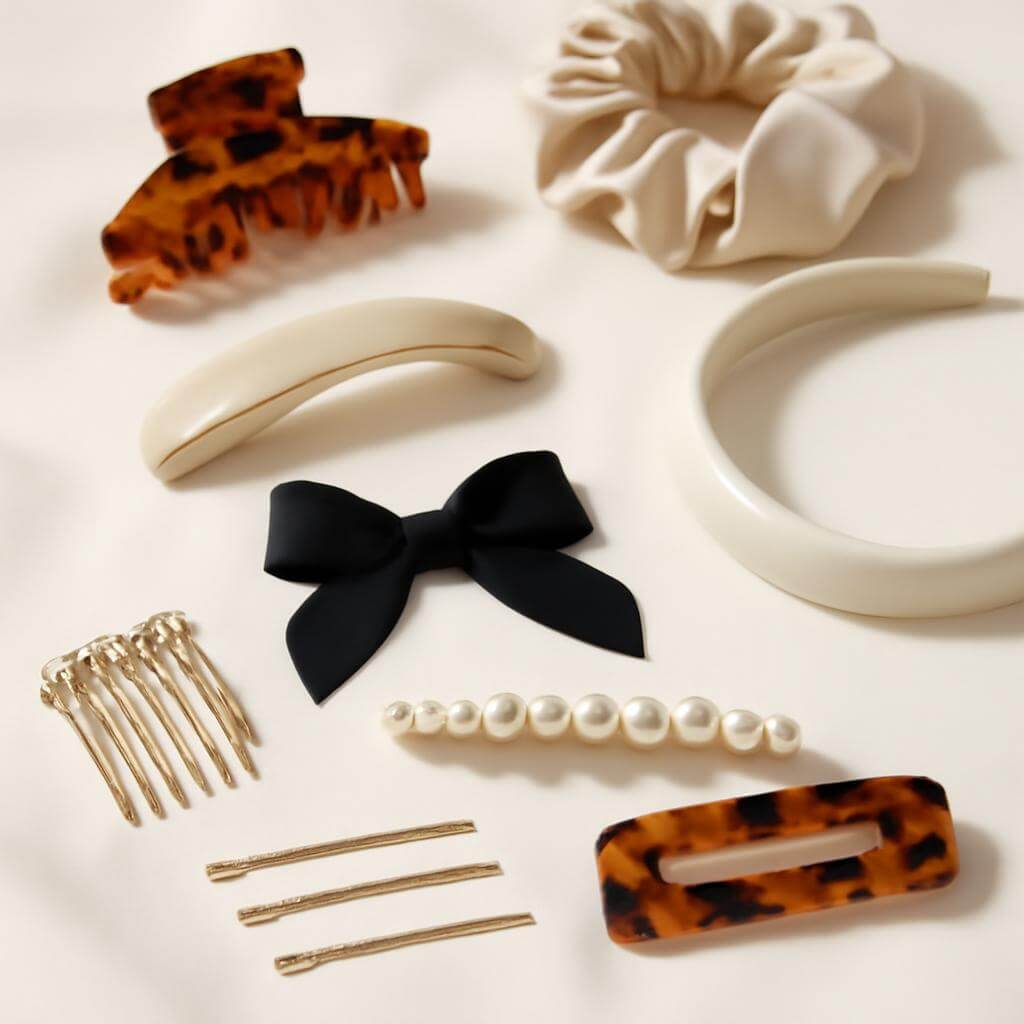
When buyers search for a hair accessory for French twist styling, they often start with one item and quickly realize the assortment should be broader. The most common wholesale styles include U-shaped French hair pins, metal hair sticks, side combs, twist combs, claw clips, bobby pins, barrettes, and decorative hair combs. Not every retailer needs all of them, but many private label lines benefit from carrying at least two or three related updo-support items.
Metal remains one of the most practical material choices for French twist pins because it offers structure and reliable hold. Stainless steel or alloy-based constructions can work well if the wire gauge, spring resilience, and tip polishing are properly controlled. Buyers should ask about plating durability and anti-fade performance, especially for gold, silver, gunmetal, and matte finishes. If the product is marketed as premium, tip smoothness and surface uniformity become especially important.
Acetate and resin are strong options for brands that want a more elevated or fashion-forward look. Acetate offers a polished appearance and works well in tortoise, marble, neutral, and seasonal color stories. Resin can support sculptural shapes and embedded decorative effects. However, buyers should review breakage resistance, weight, and edge finishing carefully, since attractive shape alone does not guarantee stable performance in an updo.
Plastic is often used for combs, claw clips, and some twist tools because it allows cost-efficient production and broader color matching. For commercial lines, the main questions are tooth strength, mold precision, hinge quality, and surface finishing. A French twist claw clip for long hair, for example, needs different spring strength and tooth depth than a small clip for short hair or half-up styling.
Decorative materials can increase perceived value, but they should be applied selectively. Faux pearl, rhinestone, satin, velvet, and organza are more common in dressy or gifting collections than in core functional updo tools. Still, they are valuable for set development. A practical wholesale strategy is to build one core functional pin or comb and pair it with softer fashion accessories such as scrunchies, bows, or embellished barrettes for coordinated launches.
Buyers evaluating category structure should compare these product directions:
- Metal U-shaped hair pins for everyday hold and salon-style functionality
- Acetate French pins for boutique retail and premium visual appeal
- Decorative combs with faux pearl or rhinestone for event and gifting channels
- French twist claw clips for fast styling and broader mass-market usability
- Bobby pin and barrette sets for lower-ticket add-on sales
One practical sourcing insight is that thickness compatibility should be discussed early, not after sample confirmation. A pin that works beautifully for medium hair may underperform for very thick or curly hair. Another is that length alone is not enough; arc shape, spacing, and insertion comfort matter just as much. Buyers who request sample testing on multiple hair densities often avoid return-related issues later.
For buyers reviewing broader category options, https://blaccessory.com/hair-accessories/ provides a useful reference point for how French twist accessories can sit within a larger wholesale hair accessories program that also includes clips, bows, headbands, and combs.
Private Label Customization, Card Packaging, and Retail Presentation
Many French twist accessories are commercially strongest when sold as branded, giftable, or display-ready items rather than loose hardware. That makes customization and packaging central to the sourcing process. For private label buyers, the product itself and the presentation need to be developed together.
Common customization options include custom color plating, acetate pattern matching, logo plates, engraved metal tags, branded woven labels for textile add-ons, hang tags, barcode labels, and display sets. In some programs, the accessory may remain unbranded while the value is built through premium retail card design and coordinated packaging. In others, especially boutique and lifestyle lines, subtle logo integration on a charm or backing card can help strengthen brand identity.
Packaging choices should reflect channel strategy. A basic OPP bag may be suitable for bulk distribution or inner-pack protection, but most retail-facing buyers prefer display cards, retail hanging cards, or compact gift boxes. Gift sets are especially effective when combining French hair pins with complementary accessories such as scrunchies, pearl clips, or headbands. This kind of set-based development can improve average order value and make seasonal launches easier to merchandise.
There are also cost and production considerations behind packaging decisions. A custom display card may require lower cost than a rigid box while still delivering strong shelf visibility. Conversely, a gift box may justify a higher retail price for holiday programs or boutique channels. Buyers should align packaging selection with target margin rather than treating all packaging upgrades as universally beneficial.
Key private label details to clarify before production include:
- Whether custom color approval will be based on Pantone reference, physical swatch, or previous order sample
- Whether logo is applied to product, card, sticker, hang tag, or box
- Whether the accessory is sold individually, as a 2-piece set, or as a multipack assortment
- Whether packaging needs retailer-specific barcode labels or multilingual compliance text
- Whether replenishment orders require exact duplication of acetate pattern, plating tone, or decorative placement
This is also where Q&N Fashion Accessory can fit naturally into supplier comparison. For buyers developing private label accessory lines, a supplier such as Q&N Fashion Accessory can support the link between product selection and presentation, which is often where French twist accessories move from being a simple styling tool to a more complete retail concept.
How Buyers Should Evaluate Suppliers for French Twist Hair Accessories
The supplier evaluation process should be strict because products in this category are small, but customer complaints can be disproportionately high if finishing is poor. A sharp edge, weak spring, loose pearl, uneven plating, or unstable curve can quickly undermine a style that is marketed as effortless and elegant.
MOQ is one of the first practical filters. Some French twist accessories, particularly standard metal pins or simple plastic tools, may allow relatively accessible order quantities. More custom acetate shapes, new molds, decorative add-ons, or branded packaging can push MOQ higher. Buyers should ask whether MOQ applies per style, per color, per packaging design, or per total order value, since that changes assortment planning significantly.
Sampling is equally important. A sample should not only confirm appearance; it should verify performance. Buyers should test grip strength, insertion comfort, finish smoothness, plating adhesion, and packaging fit. If the item is meant for thick hair, long hair, or curly textures, those use conditions should be part of sample review. In many cases, a quick sample revision on curve or tip polishing makes a meaningful difference in sell-through and customer satisfaction.
Lead time should be considered in layers. Sample lead time, bulk production lead time, packaging confirmation time, and shipping readiness are all separate milestones. Buyers launching seasonal accessory programs should work backward from in-store date rather than estimated factory completion date. This is especially relevant for French twist accessories sold in spring event seasons, holiday gifting periods, or coordinated fashion color drops.
Quality control is where reliable suppliers stand out. For this category, QC should cover:
- Tip smoothness and edge finishing
- Consistent arc shape and dimensional tolerance
- Plating uniformity and visible scratch inspection
- Grip strength or spring function where applicable
- Attachment security for faux pearl, rhinestone, or decorative parts
- Packaging count, barcode placement, and display card alignment
Another sourcing insight is reorder stability. A buyer may accept natural variation in acetate pattern, but not in size, holding function, or visible metal finish mismatch. If a product performs well on first order, the supplier should be able to reproduce it with predictable consistency. That is often more valuable than simply offering a wide range of shapes.
External industry references such as Grand View Research can be useful when buyers assess broader beauty and fashion accessory demand trends, but daily sourcing decisions still come down to sample integrity, communication clarity, and manufacturing discipline.
Strategic Recommendations for Wholesale and OEM Buyers
For many importers and private label brands, the most effective way to approach this category is not to treat the French twist as a single-product trend. Instead, treat it as a styling story that can anchor a small but scalable collection. Start with one core functional item, such as a metal or acetate French hair pin, then build adjacent SKUs around it: French twist claw clips, decorative combs, bobby pin sets, or pearl barrettes. This approach gives retailers both an entry-level SKU and higher-margin companion products.
A second recommendation is to segment by user need. One style should target quick everyday hold, another should target elevated occasions, and another should suit thicker or longer hair. Buyers who separate functional performance tiers usually make clearer assortment decisions than those buying only by decoration or color trend.
Third, invest time in packaging strategy early. Display cards, gift boxes, and hanging cards are not just presentation choices; they affect freight efficiency, shelf visibility, and retail positioning. If the item is marketed as the secret to an easy updo, the front card can communicate the styling purpose immediately, which supports sell-through without heavy explanation.
Fourth, plan for reorder discipline. Lock core finishes, standard dimensions, and approved packaging files before scaling into many colors. This helps maintain color consistency and avoids confusion when replenishment demand arrives.
Finally, compare suppliers based on how well they handle both performance and branding details. Q&N Fashion Accessory is relevant here because buyers often need a sourcing partner that can support wholesale hair accessories beyond a single pin design, including coordinated materials, custom packaging, sample review, and production follow-up. When comparing wholesale accessory suppliers, practical execution matters more than trend language alone.
For broader sourcing review or category planning, buyers can also return to https://blaccessory.com/ to assess available hair accessory direction and private label development possibilities.
Frequently Asked Questions
How to put your hair in a French twist?
From a B2B perspective, this question matters because the product must support a simple and repeatable styling method. A typical French twist is created by gathering the hair, twisting it upward, folding the length inward, and securing it with a U-shaped French hair pin, comb, barrette, or twist clip. For wholesale buyers, the implication is clear: products marketed for this use should be tested for insertion ease, holding angle, and comfort. If the accessory requires too much force or technique, it may not perform well for mass retail buyers seeking an easy, beginner friendly updo solution.
How to get a French twist to hold?
The hold depends on more than appearance. Buyers should look at material rigidity, pin curve, tooth structure, spring strength, and surface smoothness. Metal French hair pins generally offer stable support for medium to thick hair, while combs and claw clips may be easier for quicker styling. In sourcing terms, the best way to reduce customer complaints is to request samples for different hair volumes and ask suppliers about grip strength control, tip polishing, and dimensional consistency. A polished finish is important, but holding performance is what drives reorder potential.
How do you hide the clip in a French twist?
This is often a design and merchandising question. Many buyers want accessories that create a clean, elegant look, which means the visible portion should be decorative or minimal while the functional structure stays discreet. French twist combs, slim barrettes, and curved claw clips can be designed so that most of the mechanism sits inside the rolled hair. When sourcing, buyers should review profile thickness, visible hardware exposure, color matching, and decorative placement. Neutral tones, tortoise acetate, matte metal, faux pearl accents, and smaller silhouette engineering all help create a more concealed finish.
How to do a French twist without a hair pin?
For wholesale assortment planning, this question highlights the need for substitute products. Not every customer wants a traditional U-shaped pin, so buyers should consider French twist claw clips, twist combs, barrettes, and structured hair combs as alternatives. This is especially useful for retailers targeting beginners, short-hair users, or shoppers who prefer fast styling tools. A good supplier can help brands develop a small French twist collection with multiple holding methods rather than relying on one item alone.
What MOQ is typical for custom French hair pins or twist accessories?
MOQ varies by material, mold complexity, and packaging level. Standard metal or plastic items may allow more flexible quantities, while custom acetate patterns, new molds, logo plates, or gift box packaging usually increase minimums. Buyers should clarify whether MOQ is set per style, per color, or per packaging combination. It is also wise to ask whether mixed colors under one design are possible, since this can improve assortment flexibility without overloading inventory. The best MOQ is not simply the lowest one; it is the one that fits the retail plan and margin structure.
What should buyers request before placing a bulk order for French twist hair accessories?
Before confirming bulk production, buyers should request a full sample review covering material, dimensions, finish, grip performance, decoration security, and packaging approval. For private label orders, they should also confirm logo artwork, display card layout, barcode label placement, and color references. Reorder stability should be discussed at the start, especially for acetate, resin, plating, pearl, and rhinestone details. Buyers sourcing through https://blaccessory.com/hair-accessories/ or the main site at https://blaccessory.com/ should use the same checklist: sample function, packaging accuracy, MOQ structure, production lead time, and QC expectations.