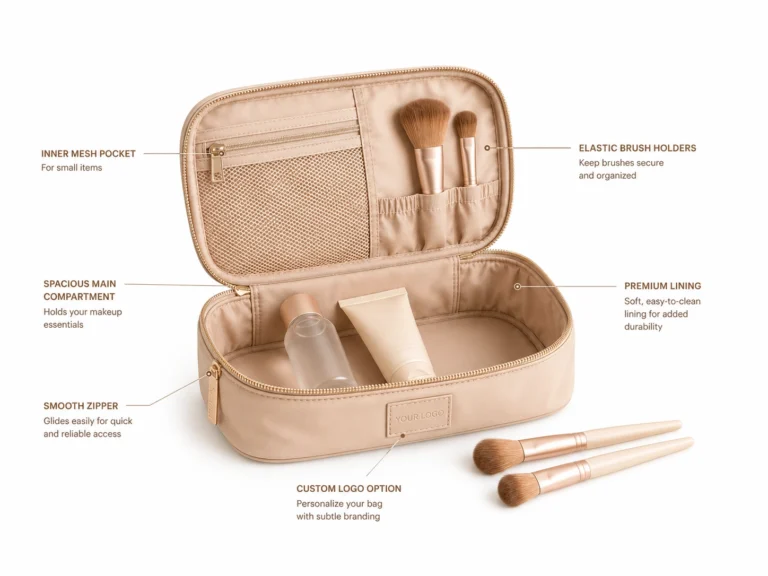
For B2B buyers, choosing a leak-resistant lining for makeup pouches requires more than selecting a shiny material described as “waterproof.” The lining film, textile base, coating weight, seam construction, zipper, needle holes, binding, and bag shape work as one system. This guide compares the most common lining options, explains realistic performance levels, outlines testing methods, and shows how to write a supplier specification that reduces leakage complaints without making the bag unnecessarily stiff or expensive.
What a Leak-Resistant Lining for Makeup Pouches Means
Leak resistance is a performance level, not a single material label. A lining may resist water penetration through its surface while allowing liquid to escape through stitch holes, zipper ends, or unsealed seams. “Water repellent,” “water resistant,” “waterproof,” and “watertight” should not be used as interchangeable claims.
| Term | Reasonable Meaning | Typical Construction | Buyer Warning |
|---|---|---|---|
| Wipe-clean | Surface can be cleaned with a damp cloth | Polyester, nylon, or coated fabric lining | Does not imply spill containment |
| Splash resistant | Resists brief external droplets | Coated lining and standard sewn seams | Zipper and seams may admit water |
| Spill resistant | Slows migration of a small internal spill | Coated lining, controlled seams, raised construction | Performance depends on spill volume and time |
| Waterproof material | Material passes an agreed water-penetration test | Continuous film or coated textile | The finished bag may still leak |
| Watertight bag | Complete product contains or excludes water under a defined test | Welded seams and specialized closure | Requires finished-product validation |
ISO 811 describes a hydrostatic pressure method for measuring a fabric’s resistance to water penetration. It is useful when comparing coated textiles, but it does not validate a finished cosmetic pouch. A bag-level test must include seams, corners, zipper installation, and the actual duration and volume of exposure. [External source: ISO 811 water-penetration test]
Why Lining Performance Matters to Beauty Buyers
Grand View Research estimates that the global cosmetic and toiletry containers market was worth USD 32.4 billion in 2023 and may reach USD 46.5 billion by 2030. Growth in skincare, travel formats, premium beauty, and reusable packaging increases the number of products carried inside pouches—and many of those products are liquids, oils, gels, creams, and powders that stain. [External source: Grand View Research]
A good lining protects more than the shell fabric. It reduces odor retention, allows easier cleaning, supports the bag’s shape, covers internal seams, and helps a brand meet the consumer’s expectation that a reusable pouch should survive normal spills. However, overengineering can create new problems. Thick films can crack at folds, make the bag noisy, increase sewing difficulty, and consume interior volume. The best lining is therefore the lightest construction that reliably meets the intended use.
Common Leak-Resistant Linings for Makeup Pouches
PEVA
PEVA is a polyethylene-vinyl acetate material often selected as a chlorine-free alternative to PVC. It is commonly used as a film or laminated layer in toiletry bags, lunch bags, shower products, and promotional pouches. PEVA can be smooth, easy to wipe, relatively lightweight, and cost-effective. It is a practical choice for everyday spill resistance when the bag does not require repeated hard folding or high abrasion performance.
Its limitations vary by grade. Thin PEVA can tear around needle holes, wrinkle during sewing, or feel inexpensive. Low-temperature flexibility, odor, transparency, and surface blocking should be assessed on the actual sample. Buyers should not assume that all PEVA is chemically identical or equally durable simply because the material name is the same.
TPU Film or TPU-Laminated Fabric
Thermoplastic polyurethane offers flexibility, clarity, abrasion resistance, and weldability. It can be used as a standalone clear film or laminated to polyester or nylon. TPU is often preferred for premium, technical, or performance-oriented bags because it can remain softer than some PVC constructions and supports heat-welded seams when the full material system is compatible.
TPU is normally more expensive than basic PEVA or PVC. Hydrolysis resistance, yellowing, film thickness, hardness, and lamination quality differ among grades. A buyer sourcing a clear or pale TPU lining should request aging and color-stability samples, especially for warm, humid, or high-UV distribution environments.
PVC Film or PVC-Coated Fabric
PVC is widely available, transparent or colored, easy to wipe, and compatible with high-frequency welding. It can provide strong water resistance at a competitive cost. For clear beauty bags and wet-use pouches, it remains a common industrial choice because factories understand its processing behavior and can source many thicknesses and finishes.
The main concerns are weight, odor, cold cracking, yellowing, plasticizer selection, and market-specific chemical restrictions. ECHA notes that phthalates have historically been used to soften plastics such as PVC and that several are restricted under REACH. Buyers should specify the destination market and request current test evidence rather than relying on a generic “eco PVC” statement. [External source: European Chemicals Agency]
PU-Coated Polyester
PU-coated polyester is a textile with a polyurethane coating on one side. It usually feels more fabric-like than film and can be sewn with standard bag-making equipment. It is a strong option for brands that want a soft interior, lower visual plasticity, and moderate spill resistance. Depending on coating weight, it can also support lightweight structures and reduce noise.
The coating may wear, peel, or hydrolyze if the grade is unsuitable. It is not automatically leakproof at seams. Buyers should define coating location, minimum coating performance, hand feel, and whether the coated face should be visible or hidden.
Nylon With Water-Resistant Coating
Coated nylon creates a smooth, premium interior and is often used in travel organizers and higher-end makeup bags. It offers good tear strength at low weight and can be dyed in refined colors. It is more forgiving during sewing than loose film, but its water resistance depends on the coating and may decrease with abrasion or repeated flexing.
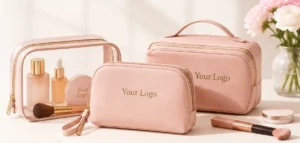
Leak-Resistant Lining for Makeup Pouches: Comparison
| Material | Hand Feel | Spill Resistance | Relative Cost | Manufacturing Notes | Best Fit |
|---|---|---|---|---|---|
| PEVA | Soft to crisp film | Good surface resistance | Low to medium | Can tear or wrinkle if too thin | Promotional and everyday pouches |
| TPU | Soft, elastic, technical | High when correctly constructed | High | Weldable; grade selection is critical | Premium and performance bags |
| PVC | Flexible to stiff film | High material resistance | Low to medium | Easy to weld; compliance must be controlled | Clear, wet-use, and value programs |
| PU-coated polyester | Textile-like | Moderate to high | Medium | Easy to sew; coating can abrade | Soft private-label bags |
| Coated nylon | Smooth and premium | Moderate to high | Medium to high | Lightweight; seam leakage remains possible | Travel and prestige collections |
Pros and Cons by Material
PEVA pros: economical, wipeable, light, and widely available. Cons: inconsistent grades, possible wrinkling, and weak stitch-hole resistance in thin films.
TPU pros: flexible, durable, weldable, and suitable for premium positioning. Cons: higher cost and greater sensitivity to grade, thickness, and processing.
PVC pros: strong clarity, easy cleaning, welding compatibility, and competitive pricing. Cons: weight, odor, aging, and chemical-compliance concerns.
Coated textiles pros: softer hand feel, easier sewing, and better integration with fabric bags. Cons: the coating can wear and sewn seams remain leakage paths.
How to Choose a Lining Step by Step
Step 1: Define the Spill Scenario
List the products likely to be carried and the realistic failure. A powder spill requires easy cleaning but not waterproof construction. A facial oil or self-tanner may stain and migrate quickly. A toiletry pouch carrying shampoo bottles needs stronger spill containment than a lipstick pouch. Specify liquid type, approximate volume, contact time, and whether the bag will remain upright.
Step 2: Decide the Required Hand Feel
A lining is part of the user experience. A premium vanity case may need a soft woven nylon interior. A transparent swim pouch can accept a film. A small promotional bag may prioritize cost. Ask for multiple swatches at realistic thicknesses and fold them repeatedly. A flat swatch can feel acceptable but become noisy or bulky inside a compact bag.
Step 3: Match the Lining to the Outer Structure
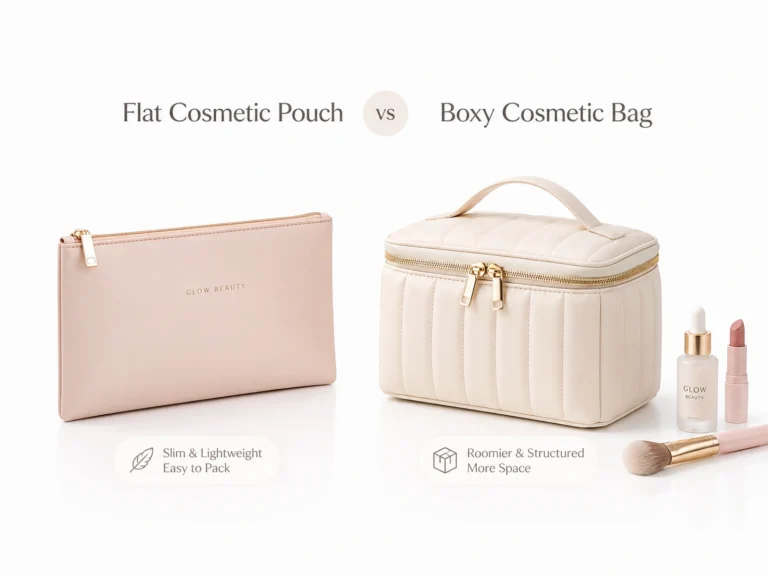
Soft shells need a lining that moves without pulling. Structured cases can support thicker laminations. Quilted bags require enough slip to avoid puckering. Clear PVC shells may not need a separate lining, but exposed seams and edge binding must still be evaluated. If the lining also provides shape, include its stiffness in the sample approval rather than treating it as a hidden component.
Step 4: Establish Cleaning Expectations
Test the actual cosmetics likely to contact the lining. Foundation, lipstick, mascara, oil, and self-tanner behave differently. A white cloth wipe test may show color transfer, while a stain test reveals whether pigment remains after cleaning. The care claim should reflect the approved method: wipe with damp cloth, mild soap only, hand wash, or no machine washing.
Step 5: Control Thickness and Color
State film thickness or fabric weight with tolerance, not only a material name. Approve color on the final substrate because translucent films change over dark interlinings and colored shells. Pale linings reveal stains but improve visibility. Dark linings hide marks but can make small items harder to find.
| Field | Example Requirement |
|---|---|
| Material | 210D polyester with PU coating on reverse |
| Color | Warm beige, approved physical swatch |
| Performance | No visible penetration during agreed 30-minute spill test |
| Cleaning | Foundation removable with damp cloth and mild soap |
| Seams | Bound seams with minimized needle holes; no raw edges |
| Chemical compliance | Current REACH/SVHC requirements for EU destination |
| Approval | Signed pre-production sample and sealed lining swatch |
How Seam Construction Changes Leak Resistance
Standard Sewn Seams
Sewn seams are flexible, economical, and compatible with most bag shapes. However, every needle penetration creates a potential path for liquid. A coated lining can slow leakage, but liquid may travel through thread, seam allowance, or capillary channels. For moderate spill resistance, place seams away from the lowest point of the bag and avoid unnecessary stitching through the lining.
Bound or Reinforced Seams
Binding covers raw edges and improves appearance, but it does not automatically seal the seam. In some designs, binding can absorb liquid and spread it. Use low-absorption tape when moisture exposure is likely, and test the assembly rather than assuming that a neat finish is a sealed finish.
Seam-Sealing Tape
Seam tape can cover needle holes on compatible coated fabrics. Success depends on adhesive chemistry, coating type, temperature, pressure, dwell time, and seam geometry. Small cosmetic bags contain tight curves and intersecting seams that are more difficult to tape than flat outdoor garments. Prototype before committing to a claim.
Heat-Welded Seams
Thermoplastic films such as compatible PVC and TPU can be joined without needle holes through high-frequency, hot-air, or heat-press processes. Welding can create stronger liquid containment, but it limits material combinations and often requires tooling. It also produces visible weld lines and may distort thin or highly transparent films.
Testing and Inspection Plan
| Test | Purpose | Suggested Stage |
|---|---|---|
| Hydrostatic pressure | Compare water penetration through coated materials | Material qualification |
| Coating adhesion | Check peeling or delamination | Material qualification |
| Flex and fold | Reveal cracking, whitening, and noise | Sample development |
| Stain-cleaning test | Evaluate foundation, oil, lipstick, and mascara removal | Pre-production sample |
| Internal spill test | Observe leakage through seams and zipper ends | Finished sample and production |
| Abrasion test | Assess coating wear from bottles and tools | Qualification or laboratory testing |
| Aging test | Check odor, yellowing, tackiness, and hydrolysis | High-risk materials or markets |
ASTM D751 includes test methods for coated fabrics, including hydrostatic resistance and coating adhesion. The exact method and pass criterion should be agreed with the laboratory because a standard test name alone does not define the buyer’s acceptable performance. [External source: ASTM D751]
Chemical and Market Compliance
Material selection must reflect the destination market and product use. The European Commission’s REACH framework controls chemicals in substances, mixtures, and articles, while ECHA maintains candidate and restricted-substance information. For PVC, printed coatings, adhesives, and synthetic leather, buyers should request current declarations and test reports tied to the actual material lot or formulation whenever possible. [External source: European Commission REACH overview]
OEKO-TEX STANDARD 100 is another useful reference for textiles tested for harmful substances, but certification scope must be checked. A certified fabric does not automatically cover every coating, ink, adhesive, zipper, or finished bag. [External source: OEKO-TEX]
Anonymized Factory Case: The Lining Passed, the Bag Failed
A skincare brand selected a smooth PU-coated polyester lining for a travel pouch. The material swatch resisted water during a simple surface test, so the buyer described the bag as leak resistant. In the first finished sample, a measured amount of colored water remained inside the lining for several minutes, but then appeared along the bottom binding and side seam.
Inspection showed that the coating itself had not failed. Liquid entered the needle holes, traveled into the seam allowance, and was absorbed by the woven binding. The zipper end also sat below the intended fill line. The revised design raised the zipper ends, reduced stitching through the lowest panel, changed the internal binding, and added a folded lining base that moved the primary seam away from the bottom.
The second sample did not become a watertight container, but it met the brand’s realistic requirement: containing a small toiletry spill long enough for the consumer to notice and clean it. The case demonstrates why material tests and bag tests answer different questions. Before publication, replace this anonymized account with verified project photographs and approved test conditions if the brand wishes to present it as first-party evidence.
Frequently Asked Questions
What is the best lining for a makeup bag?
There is no universal best lining. PU-coated polyester or nylon is often the best balance for soft private-label cosmetic bags. PEVA is useful for cost-sensitive wipe-clean pouches. TPU suits premium or weldable constructions. PVC is practical for clear and wet-use products when compliance and aging are controlled.
Is PEVA waterproof?
PEVA film can resist water penetration, but a PEVA-lined sewn bag is not automatically waterproof. Needle holes, seams, zipper ends, and tears can allow leakage. The buyer should define a finished-bag spill test instead of relying only on the material description.
How do manufacturers make a cosmetic bag leak resistant?
They combine a low-permeability lining with controlled seam placement, compatible thread and binding, raised zipper ends, suitable opening geometry, and sometimes seam sealing or welding. The bag is then tested with a defined liquid volume and exposure time.
Which lining is easiest to clean?
Smooth films such as PVC, PEVA, and TPU are generally easiest to wipe. Smooth coated polyester and nylon also clean well while feeling more textile-like. Very light colors, textured surfaces, and absorbent bindings may retain visible stains.
Can a fabric-lined cosmetic bag contain a leaking bottle?
It may slow a small spill if the fabric has an effective coating and the seams are designed carefully. It should not be promised as watertight without testing. For high-risk liquids, consider a removable clear pouch, welded insert, bottle loops, or upright compartments.
How should buyers test a leak-resistant lining?
Start with material-level water penetration and coating adhesion, then perform finished-bag tests using representative cosmetics or colored test liquid. Record volume, time, orientation, temperature, and acceptance criteria. Repeat after flexing or aging if the product is expected to have a long service life.
Does a thicker lining always provide better leak resistance?
No. Thickness may improve puncture resistance, but it can also increase stiffness and create difficult seams. Coating continuity, material chemistry, seam construction, and workmanship often matter more than thickness alone.
Expert Recommendation, CTA, and Future Trend
Choose a leak-resistant lining for makeup pouches by use case, not by marketing label. For an everyday soft makeup pouch, a quality PU-coated polyester or nylon lining with well-controlled seams is often the most balanced option. Choose PEVA when cost and easy cleaning lead the brief. Choose TPU when flexibility, welding, or premium performance justify the price. Choose PVC when clarity, welding efficiency, and cost are important—and control restricted substances, odor, and aging carefully.
The next generation of beauty bags will use lighter coatings, recycled base textiles, mono-material constructions, removable washable inserts, repairable parts, and more precise performance claims. Buyers will increasingly ask suppliers to show how the whole bag performs, not simply provide a “waterproof fabric” certificate.
To develop a custom pouch, share the intended contents, spill scenario, size, outer material, target market, quantity, and cleaning expectation with Bling Accessory. A material swatch, constructed sample, and documented spill test will provide a more reliable decision than a lining name alone.