For B2B buyers, the choice between sewn seams and heat-welded seams affects water resistance, shape, minimum order quantity, tooling cost, repairability, mixed-material design, and final appearance. Neither method is automatically better. The correct choice depends on the film, thickness, bag geometry, zipper, intended use, and performance claim. This guide provides a detailed comparison for clear PVC, TPU, and related thermoplastic beauty bags.
Sewn Seams vs Heat-Welded Seams: Why It Matters
Grand View Research values the global bags and containers market at approximately USD 48.2 billion in 2024 and projects it to reach about USD 62.2 billion by 2030. Within travel, beauty, promotional, and retail packaging, clear bags continue to be used because they display products, simplify organization, and support security-friendly or wet-use applications. [External source: Grand View Research]
Seam construction determines whether the clear material behaves like a flexible textile, a formed plastic package, or something between the two. Sewing physically pierces and joins layers with thread. Welding softens compatible thermoplastic surfaces and fuses them under pressure. These mechanisms create different strengths and different failure patterns.
| Area | Sewn Construction Influence | Welded Construction Influence |
|---|---|---|
| Appearance | Visible stitch, binding, seam allowance | Visible weld band, cleaner edge potential |
| Water resistance | Needle holes create leakage paths | Continuous fusion can reduce leakage |
| Design freedom | Supports zippers, fabric trims, labels, piping | Best with compatible thermoplastics |
| Tooling | Standard sewing equipment and guides | Welding dies, electrodes, fixtures, or settings |
| MOQ | Often lower for new shapes | May rise when custom tooling is required |
| Failure mode | Torn holes, broken thread, seam slippage | Under-weld, burn-through, delamination |
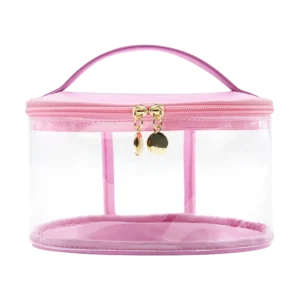
How Sewn Seams Work on Clear Beauty Bags
Basic Construction
In a sewn clear bag, PVC or TPU panels are cut and assembled with a lockstitch machine, often with fabric or synthetic binding over the raw edge. The zipper may be sewn directly to the film, attached through a fabric zipper panel, or inserted into a bound top opening. Reinforcement tape can be placed behind high-stress areas to reduce tearing around needle holes.
Sewing allows a factory to combine clear film with polyester, nylon, canvas, PU, webbing, mesh, elastic, foam, lining, and decorative hardware. This is why sewn construction dominates transparent cosmetic bags that use colored trims, handles, gussets, internal pockets, or conventional zippers.
Advantages of Sewn Seams
- High flexibility for mixed-material designs
- Lower tooling requirement for new shapes
- Easier small-batch sampling and revision
- Broad compatibility with zippers and fabric components
- Repairable or reworkable in some production situations
- Familiar process for most soft-bag factories
Limitations of Sewn Seams
Needle holes are permanent. In soft PVC, closely spaced holes can act like a perforated tear line. In cold conditions, an unsuitable film may crack around stitches. In thin TPU, the presser foot and feed dog can stretch or mark the surface. Sewing can also create puckering when the film and fabric trim feed at different rates.
Water can pass through the stitch line or travel along thread. Even when the film itself is waterproof, the finished seam usually is not. Binding may absorb liquid and extend the wet area. For this reason, a sewn clear toiletry bag should normally be described as wipe-clean or splash resistant unless finished-product testing supports a stronger claim.
Common Sewn Seam Options
| Construction | Visual Result | Performance Note | Typical Use |
|---|---|---|---|
| Bound seam | Colored edge, hidden raw film | Good reinforcement; not sealed | Cosmetic pouches and travel bags |
| Turned seam | Cleaner outside face | Can be bulky and difficult in stiff film | Premium mixed-material bags |
| Flat overlay seam | Visible stitch rows | Simple but exposes needle holes | Flat document or sample pouches |
| Reinforced zipper seam | Fabric panel around zipper | Reduces stress on film edge | Curved vanity and organizer bags |
| Double-needle seam | Technical appearance | More holes; requires careful spacing | Large bags with reinforced film |
How Heat-Welded Seams Work
The Welding Principle
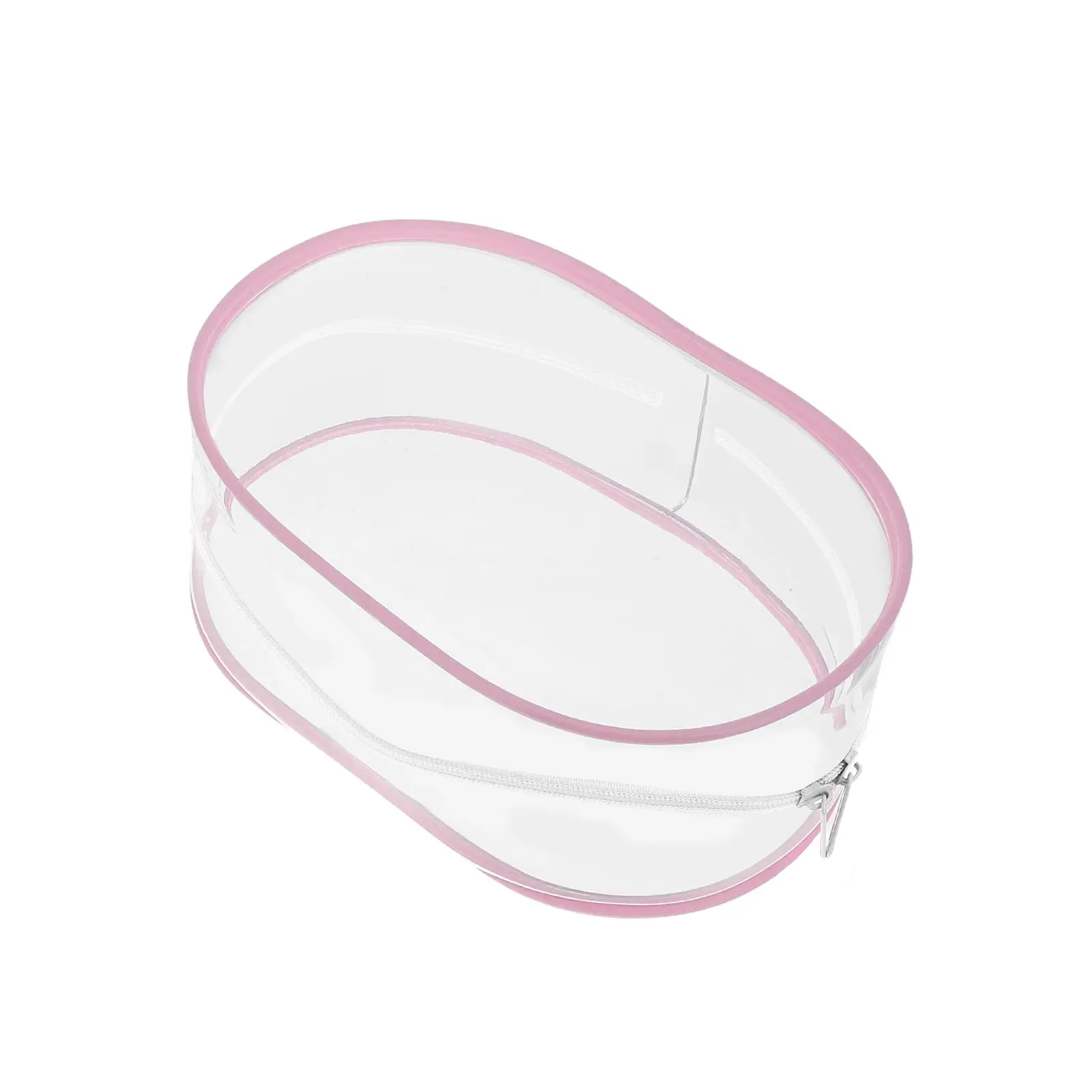
Heat welding joins thermoplastic layers by applying controlled energy and pressure until the contact surfaces fuse. Depending on the material and factory equipment, the process may use high-frequency radio waves, hot air, a heated bar, impulse sealing, or ultrasonic energy. The seam cools under pressure and becomes a continuous joint.
Leister identifies PVC, TPU, TPO, EVA, and other thermoplastic membranes as weldable materials and emphasizes the need to control temperature, speed, air volume, and pressure. Cosmetic bags use smaller-scale machines and fixtures, but the same principle applies: the process window must be stable enough to fuse the film without burning, shrinking, whitening, or distorting it. [External source: Leister technical textiles]
High-Frequency Welding
High-frequency, or RF, welding is especially common for flexible PVC. An electrode shaped like the seam presses the layers while electromagnetic energy heats the polar material internally. The process can create clean, repeatable bands and can combine sealing with embossing or decorative contours. Custom electrodes may be required for curved shapes, logo impressions, or complex seams.
Hot-Air and Heat-Press Welding
Hot-air welding directs heated air between overlapping thermoplastic surfaces, followed by pressure rollers. Heat presses or impulse sealers apply heat through bars or dies. These methods can work with compatible TPU and PVC films, but thin transparent materials reveal every setting error. Testing must establish the correct temperature, pressure, dwell time, overlap width, and cooling period.
Advantages of Heat-Welded Seams
- No sewing needle holes in the welded area
- Potentially better liquid and air containment
- Clean, modern, minimal appearance
- No thread breakage or loose thread defects
- Repeatable seam width when tooling is stable
- Useful for clear pouches, waterproof inserts, and inflatable structures
Limitations of Heat-Welded Seams
Welding requires compatible thermoplastics. A PVC body cannot always be welded reliably to a TPU trim, and a coated fabric may fail at the coating-to-textile bond even when the surface weld appears strong. Zippers, labels, handles, and decorative panels may still need sewing or special welded attachments.
Tooling increases development cost. Welded shapes can also be harder to revise because a dimensional change may require a new electrode or fixture. Under-welding produces weak peel strength; overheating causes burn-through, hard edges, gloss changes, bubbles, or shrinkage. A visually neat weld is not proof of sufficient strength.
Sewn Seams vs Heat-Welded Seams by Material
PVC
Flexible PVC is highly compatible with RF welding and is widely used for clear cosmetic bags. It offers stable processing, multiple colors and finishes, and competitive cost. The buyer must control thickness, softness, odor, cold-crack performance, yellowing, and restricted plasticizers. ECHA explains that several phthalates used as plastic softeners are restricted under REACH, so destination-market testing is important. [External source: ECHA]
TPU
TPU can offer better flexibility, abrasion resistance, and premium positioning. It is weldable when the resin chemistry, hardness, film surface, and equipment are compatible. TPU is usually more expensive, and some grades are sensitive to moisture during storage or processing. Buyers should approve actual film and welded samples rather than asking for “TPU equivalent” without a grade.
Coated Fabrics
Polyester or nylon coated with PVC or TPU can be welded coating-to-coating. However, the finished seam may fail by coating delamination rather than weld separation. ASTM D751 includes methods relevant to coated fabrics, including coating adhesion and hydrostatic resistance. [External source: ASTM D751]
| Material System | Sewing | RF Welding | Hot-Air/Heat Welding | Key Risk |
|---|---|---|---|---|
| Flexible PVC film | Yes, with controlled needle and reinforcement | Excellent | Good | Perforation, plasticizer compliance, heat marks |
| TPU film | Yes, but may stretch | Grade dependent | Good when compatible | Heat window, blocking, hydrolysis |
| PVC-coated polyester | Yes | Good coating-to-coating | Good | Coating delamination |
| TPU-laminated nylon | Yes | Grade dependent | Good | Laminate peel strength |
| Mixed PVC and TPU | Usually sewable | Unreliable without validation | Unreliable without validation | Chemical incompatibility |
Sewn Seams vs Heat-Welded Seams: Comparison
| Requirement | Sewn Seam | Heat-Welded Seam |
|---|---|---|
| Lowest development cost | Usually better | May require tooling |
| Small pilot order | Usually easier | Possible, but setup cost may dominate |
| Mixed materials | Strong advantage | Limited by compatibility |
| Liquid resistance | Limited unless sealed | Potentially high |
| Design revisions | Relatively easy | Can require new tooling |
| Minimal appearance | Stitching remains visible | Clean weld band possible |
| Curved 3D shapes | Flexible but skill dependent | Tooling and process dependent |
| Repairability | Some seams can be resewn | Repair can be difficult |
Pros and Cons in Practical Terms
Sewn seams provide the greatest design freedom and usually the lowest barrier to sampling. They are ideal when a clear bag includes fabric binding, handles, pockets, lining, or standard zippers. Their disadvantages are visible stitching, needle-hole weakening, and limited water resistance.
Heat-welded seams can create a cleaner appearance and stronger containment. They are ideal for flat clear pouches, waterproof inserts, simple geometries, and high-volume programs where tooling cost can be spread across units. Their disadvantages are material restrictions, setup cost, process sensitivity, and limited revision flexibility.
How to Choose the Right Seam Construction
Step 1: Define the Claim
Decide whether the bag only needs to be transparent and wipe-clean, resist splashes, contain a small internal leak, or remain watertight under pressure. Do not choose welding merely because the word sounds stronger. A welded body with an unsealed zipper may still fail the intended test.
Step 2: Map Every Joint
Create a seam map showing body panels, zipper installation, handle attachments, labels, corners, and opening ends. Some designs use a hybrid system: welded clear body panels, sewn zipper tape, and reinforced handle patches. Evaluate the weakest joint rather than the strongest seam.
Step 3: Review Material Compatibility
Ask the supplier to identify film chemistry, thickness, hardness, coating side, and welding method. For mixed materials, request peel samples. A visual bond test is insufficient. If the supplier cannot explain whether failure occurs in the weld, coating, laminate, or base fabric, the development risk is high.
Step 4: Compare Tooling Against Order Volume
A custom RF electrode may be economical for tens of thousands of pieces but disproportionate for a 500-piece launch. Ask for separate quotations for tooling, sampling, and unit production. Confirm whether the tooling belongs to the buyer, how long it will be stored, and whether future dimensional changes require replacement.
Step 5: Prototype the Final Geometry
Test the actual bag, not only flat seam strips. Fill it, flex it, expose it to expected temperature, and repeat opening cycles. Clear materials often become stiffer in cold conditions, and tight corners concentrate stress. The pre-production sample should represent production film, seam width, zipper, and reinforcement.
Quality Testing for Sewn and Welded Seams
ISO 13935-2:2026 describes a grab method for determining maximum force to seam rupture in fabrics and made-up textile articles. Although clear film bags may require adapted methods, the standard reinforces an important principle: seam strength must be measured as a constructed joint, not inferred from base material strength alone. [External source: ISO 13935-2:2026]
| Test | Sewn Seam Focus | Welded Seam Focus |
|---|---|---|
| Visual inspection | Stitch spacing, skipped stitches, binding alignment | Weld width, bubbles, burn marks, distortion |
| Pull test | Hole elongation, thread break, seam slippage | Peel, shear, coating delamination |
| Leak test | Needle holes, corners, zipper ends | Incomplete weld and intersections |
| Flex test | Cracking around stitches | Hard-edge cracking and weld fatigue |
| Cold test | Film brittleness and perforation tearing | Weld embrittlement or separation |
| Drop/load test | Stress at sewn attachments | Stress concentration beside weld |
Set acceptance criteria before production. “No leakage” is incomplete unless the buyer defines the test liquid, volume, duration, orientation, temperature, and whether moisture at the zipper is acceptable. For a splash-resistant pouch, a short spray test may be appropriate. For a bottle-leak containment pouch, an internal colored-water test may be more relevant.
Cost, Tooling, and MOQ Implications
Sewn and welded quotations should be compared as total program costs rather than unit prices alone. A sewn bag may have a slightly higher labor cost per unit but little dedicated tooling. A welded bag may offer efficient repeat production after the electrode, fixture, and process settings are established, yet the first order must absorb development and tooling. Ask the supplier to separate material cost, unit conversion cost, custom tooling, sample charges, and future repeat-order pricing.
MOQ is also influenced by the material roll, custom color, zipper, and packaging—not only the seam method. A welded bag made with a stock clear film and standard die may support a lower trial quantity than a sewn bag requiring custom-dyed binding. Conversely, a custom-shaped RF-welded pouch can carry a higher economic MOQ because the tooling cost cannot be justified across a small run. Buyers should request two scenarios: the lowest technically feasible quantity and the quantity that produces the most efficient unit cost.
Finally, confirm maintenance and ownership. Electrodes can wear, become damaged, or require adjustment when film thickness changes. Record the tool number, approved seam width, storage period, ownership, and replacement responsibility. For sewn production, preserve patterns, folders, guides, and stitch-setting references for repeat consistency.
Anonymized Factory Case: The Cleanest Seam Was Not the Best Design
A promotional beauty program requested a fully clear rectangular pouch with no visible binding. The initial concept used welded PVC panels and a welded top flap. The body seams were clean, but the brand later added a fabric wrist strap, a woven label, and a conventional zipper. Each new component introduced a sewn or bonded interface that interrupted the original welded construction.
The first revised sample looked inconsistent: welded side seams, sewn zipper tape, adhesive-backed label, and a strap patch that pulled on a narrow film area. The factory compared two routes. The first retained the welded body and developed reinforced welded strap tabs. The second changed to a fully sewn bag with color-matched binding and a fabric zipper panel.
Because the order was a moderate launch quantity and the design was still changing, the sewn version offered lower tooling risk and more reliable attachment strength. The brand accepted visible binding as a deliberate design feature. In a later repeat order with a stable shape and higher quantity, a more integrated welded version could be reconsidered. The case shows that a clean seam is valuable only when the entire product architecture supports it.
Frequently Asked Questions
Are heat-welded seams stronger than sewn seams?
Not automatically. A well-made weld can be highly resistant to peel, shear, and leakage, but an under-welded or overheated seam can fail quickly. A sewn seam can be very strong when the material is reinforced and the stitch design is correct. Strength should be tested on the actual material and joint geometry.
Can clear PVC bags be sewn?
Yes. Many cosmetic and travel bags use sewn PVC with fabric binding. The factory must control needle size, stitch density, thread tension, presser-foot pressure, reinforcement, and cold-crack behavior. Too many closely spaced holes can create a tear line.
Are welded clear bags waterproof?
The welded seams may resist water well, but the finished bag is only waterproof or watertight if every opening and attachment passes a defined test. Zippers, sliders, top closures, handles, labels, and seam intersections are common leakage points.
Which seam type has a lower MOQ?
Sewn construction usually supports a lower development quantity because it needs less custom tooling. Welded flat pouches can also be made in small quantities when standard dies are available, but custom shapes and RF electrodes may raise the economical MOQ.
Can TPU and PVC be welded together?
They should not be assumed compatible. Some combinations may bond under specific processes, while others peel or fail during aging. Request a documented weld trial using the exact materials. A mixed-material design is often safer when joined mechanically or redesigned around one compatible polymer system.
What seam is best for a clear makeup bag with a fabric zipper?
A sewn or hybrid construction is usually the most practical. The clear panels can be welded or sewn, but the fabric zipper tape generally needs a controlled sewn attachment unless a specialized weldable tape is specified. The zipper seam often becomes the limiting water-resistance point.
How can buyers compare two seam samples?
Compare appearance, seam width, flexibility, odor, edge hardness, pull strength, leakage, cold performance, and repeatability. Cut open failed samples to identify whether the thread, film, weld, coating, or laminate failed. Record the test conditions and retain approved samples.
Expert Recommendation, CTA, and Future Trend
When comparing sewn seams vs heat-welded seams, choose sewn seams when design flexibility, mixed materials, lower tooling cost, and easy sampling are most important. Choose heat-welded seams when the material is compatible, the geometry is stable, liquid resistance matters, and the order volume can support process development. For many clear beauty bags, a hybrid construction is the most commercially realistic solution.
Future clear-bag development will move toward phthalate-controlled PVC, premium TPU, recycled textile laminates, narrower weld bands, mono-material designs, and more transparent performance claims. Digital process monitoring will also improve consistency by recording welding temperature, pressure, speed, and cycle time.
For a construction review, send the clear material preference, bag dimensions, seam appearance, closure type, quantity, target market, and water-resistance expectation to Bling Accessory. A seam map and finished prototype can reveal cost and performance risks before tooling or mass production begins.